Small-lesion image encoder
Extends PENet with 3D channel attention, spatial attention, and depth-wise convolution fusion to capture subtle lesion regions across volumetric slices.
Paper 2709 / Medical AI
MMCAF-Net targets a practical clinical diagnosis problem: small lesions can disappear inside 3D medical images, while imaging and electronic health record features are difficult to align directly.
Abstract distilled
The paper proposes a framework that combines 3D medical image features and clinical table data. It introduces E3D-MSCA for lesion-specific multiscale image encoding, MSCA for cross-modal integration, and BSF for reducing uncertainty when fusing features across scales.
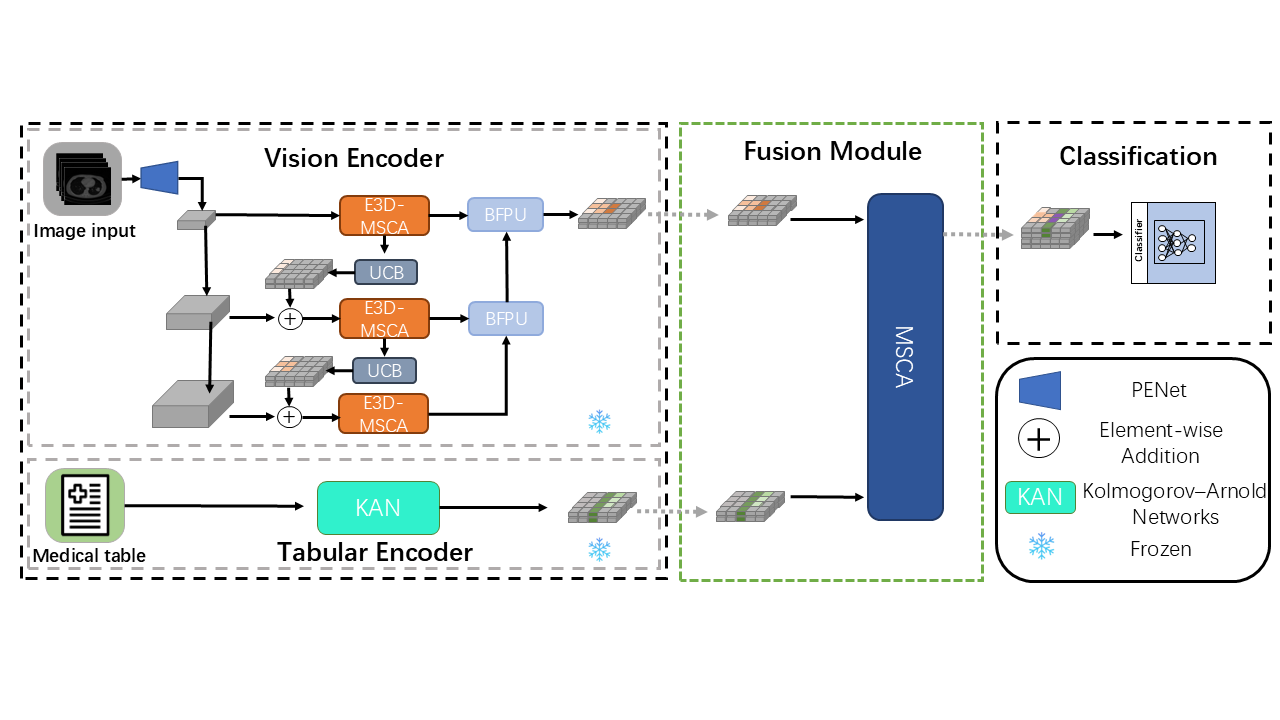
Extends PENet with 3D channel attention, spatial attention, and depth-wise convolution fusion to capture subtle lesion regions across volumetric slices.
Encodes tabular attributes such as gender, age, weight, TNM stage, and smoking history before multimodal alignment.
Uses multiscale cross attention and bidirectional scale fusion to reduce dimensional conflict between image and clinical features.
Lung-PET-CT-Dx result
On the public Lung-PET-CT-Dx dataset, MMCAF-Net outperformed comparative multimodal approaches on ACC, F1, specificity, sensitivity, PPV, and NPV. The study reports a lower false-positive tendency through a stronger PPV score.
Selected comparison